Category: Japan

  • Camp Hansen

    Located in the majestic island of Okinawa, Japan, Camp Hansen is considered as the largest United States Marine Corps training range in the island and was one of the few locations in the area that allowed the firing of live rounds.  Aside from the rudimentary military facilities of numerous firing ranges and live fire houses, also located in the camp is a brig (a confinement facility) that is used for offenders for military officers of the United States of America that are serving in the Far East (The brig, though, is only used for short and light sentences). The camp also houses a hospital, a bank, a barracks and some entertainment facilities. Present also in the base is a Post Exchange, some restaurants and convenience stores.

    Talks of the anxiety felt by the Okinawa people towards the possible danger of the occasional falling gun shells brought by the live firing exercises called for the creation of a Special Action Committee in 1996. On December 2, 1996, through an agreement between the United States and Japan, the Special Action Committee on Okinawa (SACO) released a Final Report that issued 27 recommendations on the reduction of the impact of the presence of the United States military to the island’s local inhabitants. The SACO Final Report resulted to the relocation of the live fire exercises conducted by the 3rd Marine Division from the Central Training Area to the training ranges located in mainland Japan (these ranges include Kita-Fuji, Higashi-Fuji, Ojojihara, Yausubetsu and Hijudai. Japan actually agreed to shoulder the transportation costs for the transfer of the artillery ranges and opted to use Japanese commercial airliners for the relocation. Although moved, the III Marine Expeditionary Force nonetheless agreed that the training at the five mainland ranges is still the same with that in Okinawa and even with those found in the United States.

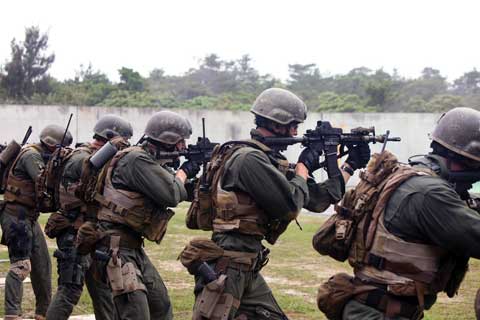
    Military action at Camp Hansen

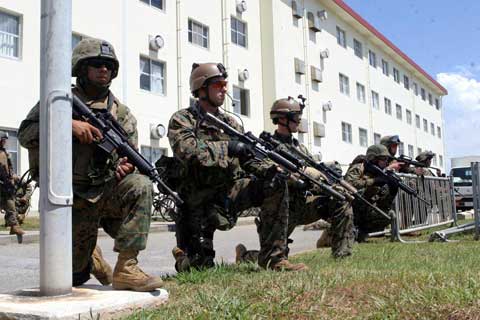
    Soldiers practice at Camp Hansen

    Camp Hansen Soldiers training

    Shooting training at Camp Hansen

    Today, the USMC had engaged in the joint use of its military bases with the Japanese Self-Defense force and Camp Hansen had opened its grounds in 2008 for the training of the Japan Ground Self-Defense.

  • Camp Fuji

    Camp Fuji, a facility controlled by the United States Marine Corps that can be found in the East Central of Japan in the island of Honshu. It is situated in the vicinity of Mount Fuji specifically at the base 800 miles from Okinawa. Camp Fuji neighbors a Japanese Ground Self-Defense Force facility which is known as Takigahara Garrison. The nearest city is the Gotenba City about 10 km away from the camp.

    Back then, during the 15th century, samurais used the camp as their training grounds. Up to today it has served as the training area for the armed forces, marines. Marine Corps from the US Army was in control of the place since it was turned over in 1953. The area is roughly 300 acres but just 30 acres of land is dedicated to maneuvers training and firing ranges and areas to provide for the marines based in the Pacific.

    Camp Fuji was then considered to be of less accommodating other than other bases since there short of family housing, recreational areas as well. But, no worries, the improvement is underway, since the middle of 1980’s the camp has undergone extensive work to perk up the base. The camp is becoming better and more convenient.

    Soldiers at practice on Camp Fuji

    Flag at Camp Fuji

    Military training at Camp Fuji

    Sign at Camp Fuji

    Now, the camp is in fact fully equipped it offers recreational facilities consisting of three gyms, volleyball and racquetball courts. It has a library and a small SNCO and Enlisted Club. There is a post office which is in full service a small health check clinic. There is a small non-commissary 7-day store. There are no banking service though but there is always an on the base club system that cashes out including personal checks and will offer yen conversions.

    The aim of Camp Fuji is to support military US Force training. It is able to provide to US Forces the facilities for administrative, communications, garrison services and logistical support that especially those who deploy there for training. The task of the camp is to coordinate the use of firing ranges and training amenities, maneuver area that gives necessary support in the units. It really serves as a full service base that makes available the entire services that is necessary for training required for heath, comfort, wellbeing, and morale.

  • Camp Zama

    Camp Zama is situated 40 km in the southwestern part of Tokyo, Japan which is a United States Army installation. This serves as the major headquarter of the United States Army stationed in Japan and houses the US Army Japan, 500th Military Intelligence Brigade, US Army Japan Aviation Detachment, 78th Signal Battalion, 4th Engineer Group of the Japan Ground Self Defense Group and the US Army Corps of Engineers.

    Camp Zama Facts

    • Website: Visit Camp Zama Website ›
    • Location: In and around the city of Zama, Japan
    • Phone: 011-81-46-407-8500
    • Latitude: 35.488611
    • Longitude: 139.407778
    • DSN: 315-263-8500

    Camp Zama is within the perimeter of Zama City while the two housing facilities, Sagamihara Family Housing Area and the Sagami Depot are situated near the city. What used to be a rural area is now an urban area with the development of new housing and shopping centers which cause population increase and traffic congestion. A trip from Tokyo and other US Army military units to Camp Zama will be met with heavy traffic congestion depending on the time of travel and the most sought after mode of transportation is the local public train transportation which is reliable and runs regularly to the city and neighboring areas.

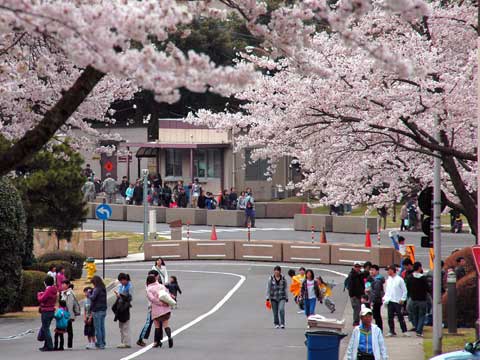
    Walkabout at Camp Zama

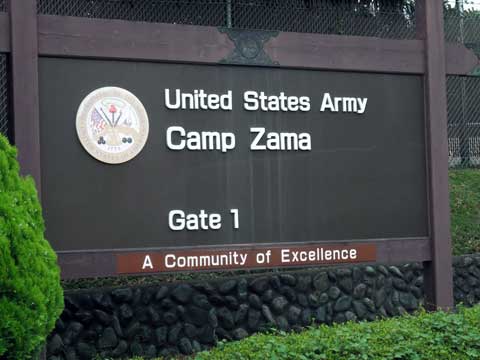
    Main sign of Camp Zama

    Entrance gate at Camp Zama

    Well known dinning facility of Camp Zama

    Camp Zama used to be the Imperial Japanese Army Academy and Route 51, the road leading to Camp Zama was built so that the Emperor of Japan can travel to the camp to review the graduating class of the academy. It also serves as safe haven for the Emperor and until now it serves as the US Army Garrison Japan. The only remaining structure left by the war was the theater workshop which is used by the Imperial Japanese Army for various ceremonies.

    During the March 2011, the unforeseen crisis of the Fukushima I nuclear accidents, the Tohoku earthquake and tsunami, the Camp Zama personnel assisted the Operation Tomodachi wherein the 300 families of the American personnel voluntarily left the base for relocation outside Japan.

  • Camp Kinser

    It is part of the Marine Corps of US that is located in Okinawa. Camp Kinser houses Naha Port, a US Army military unit. Camp Kinser’s primary mission is to provide support to the US Marine logistics operations.  Kinser Camp has a warehouse with one million square feet of space to house all the Marine forces’ storage utilities in the Pacific. The warehouses keep war supplies on Okinawa which includes 5,000 of equipment, 50 million gallons of fuel and about 14,400 loads of ammunitions.

    Camp Kinser Facts

    • Website: No known website for Camp Kinser
    • Location: Okinawa Island, Japan
    • Phone: 011-81-98-911-5111
    • Latitude: 35.748611
    • Longitude: 139.333333
    • DSN: 315-640-1110

    Makiminato Service Area, another name for Camp Kinser is based in Urasoe City which is 3km on the northern and southern far from the National Highway 58 running to the west side of the coastal area and runs 1km east to west. Makiminato was used as a housing area and on 1980 it was returned to Okinawa. On December 2, 1996, Japan and the United States signed the Final Report of the Special Action Committee in Okinawa which states the reduction of the presence of the US Military to the people of Okinawa and because of this many planned operations in the base have been put aside.

    Soldiers at Camp Kinser

    Machine at Camp Kinser

    Barracks at Camp Kinser

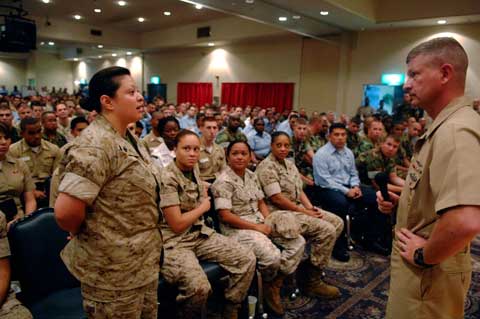
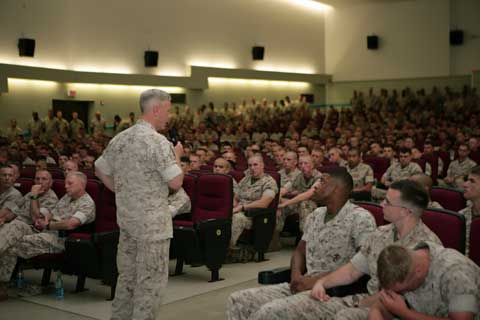
    Soldiers speech at Camp Kinser

    One of this is the use of the exhausted uranium in the training area wherein the Japanese authorities are worried that it could harm their environment. It was on June 2000, that JCP Okinawa Prefectural Committee Chair Seiken Akamine requested the US and the Japanese government to face the problem on check up health and environmental damage, remove the DU-bullets from US Kadena arsenal depot and disclose the information on the related military-waste disposal in the Camp Kinser.

    Since the base is located in the central part of Okinawa and the facility inside the base is not that much, there are lots of available comfortable accommodations and amusement amenities around the area.

  • Camp Lester (Camp Kuwae)

    Camp Lester, another name for Camp Kuwea is situated along the coastline of the Chatan Town which faces the East China Sea. This is where the largest military hospital in Okinawa is based aside from having the different amenities such as a soccer field, school, and housing facilities catered to the surrounding bases within the area. There is also a town office that also falls under the agreement SOFA which states that the land will be returned slowly to the people of Japan to reduce the presence of the US military men in the area.

    Camp Lester Facts

    • Website: No known website for Camp Lester
    • Location: Chatan Town located on a flat piece of coastline facing the East China Sea, Japan
    • Phone: 011-81-98-911-5111
    • Latitude: 26.316667
    • Longitude: 127.766667
    • DSN: 315-640-1110

    Camp Lester is under the Japan and United States agreement which they signed under the Final Report of the Special Action Committee on December 2, 1996 which states the reduction of the US military presence in the area. Included in this agreement is the return of Camp Lester which has an area of 245 acres of land on March 2008. This will take effect after the transfer of the naval hospital to Camp Zukeran and the other facilities in Okinawa. This also includes the merging of the housing facilities in Camp Kuwea and Camp Zukeran. Though the facilities at Camp Lester are transferred to the nearby camps, these facilities are just nearby.

    Sign at Camp Lester

     US naval hospital Okinawa main sign

    Areal view of US naval hospital Okinawa

    Areal view of US naval hospital Okinawa

    The residents of Okinawa still refer Camp Lester as Camp Kuwae because they are used to call it for 30 years. It was named in honor of the Medal of Honor recipient Hospital Apprentice 1st Class Fred Faulkner Lester. Today, Camp Lester is known for the largest military hospital, the US Naval Hospital, which has the most complete facility in the naval medical treatment plus a referral center in the entire Western Pacific. The US Naval Hospital serves the 55,000 active servicemen and their families, contract and civilian employees and retirees through out the Western Pacific. It is also staffed by Air Force and US Navy personnel.

  • Commander Fleet Activities Okinawa

    The presence of United States Marine Corps forces in Okinawa provides national security in the region. They discourage aggression, answers during crises should any aggression occurs and secures any risk brought about by the withdrawal of some US forces to the stability and peace in Okinawa.

    Commander Fleet Activities Okinawa Facts

    On 2003, the US planned to move their 20,000 US Marines on Okinawa to Australia where they are planning to establish new bases. In doing this, the US Marines will increase their presence in Malaysia and Singapore, and also to continue their agreement to house their navy fleets in the grounds of the Philippines as well as the waters of Vietnam. Under this plan, the 5,000 US Marines will allow their families to go along with them.

    Okinawa’s strategic location makes them a potential place because they are near the trouble spots of the region which will reduce their transit time in going to the said place in cases of insurgency. Because of this, the early US troops called Okinawa as the “Keystone of the Pacific” because Shanghai, Manila, Hongkong, Tokyo and Seoul are only within the 1,500 km radius. In cases where there is trouble in the said locations, the US Armed Forces can move quickly with all the required facilities in supporting their response.

    Sign of Commander Fleet Activities Okinawa

    Areal view of Commander Fleet Activities Okinawa

    Commander Fleet Activities Okinawa Navy

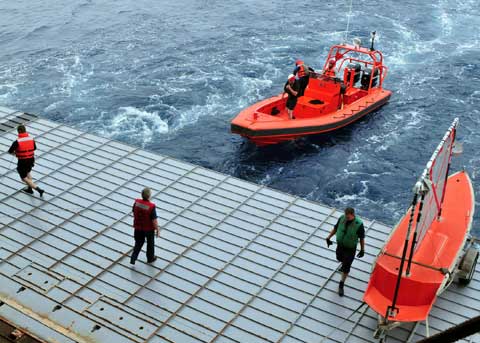
    Safety boat near Commander Fleet Activities Okinawa

    The commanding officers based in Okinawa see to it that the US military men and women who brought along their families will be well taken care of. They go to the extent of making sure that the families of the servicemen will have good living conditions, educational amenities as well as recreational amenities. They have the best educational facilities to ensure that the children will have high standard education. Anybody who is assigned in Okinawa will have nothing but good words based on how the military personnel and their dependents are taken cared of.

  • Commander Fleet Activities Sasebo

    The US Fleet Activities Sasebo is found on the island of Kyushu, Sasebo, Japan.  This is a United States naval base which was established on June 1946 whose primary mission is to provide logistic support to the deployed units and the visiting forces of the United States Pacific Fleet as well as the activities of personnel in the base.

    Commander Fleet Activities Sasebo Facts

    During the World War II, there were about 60,000 Japanese Imperial Navy working in the port and other naval stations in setting up the submarines, aircraft and ships. At present, Sasebo is still the popular port among the navy. Sasebo became the primary launching point for the US Forces and the United Nations when the war in Korea broke out. At that time, around 20,000 US troops and 100 warships grew everyday as the need for fuel, ammunition, trucks, supplies and tanks flowed on their way to Korea.

    soldiers at Commander Fleet Activities Sasebo

    boat at Commander Fleet Activities Sasebo

    Plane lands on boat at Commander Fleet Activities Sasebo

    military machine at Commander Fleet Activities Sasebo

    When the Korean War was finished, America and Japan entered into an agreement known as the SOFA which opened the door for Japan Self Defense Forces and the Japan Maritime Self Defense Forces’ ships began to dock in the ports of Sasebo. During the Southeast Asia War the US Fleet Activities Sasebo supported the expansion of the Seventh Fleet and until now there repairs being made to the different ships which is comparable to the best ships in the world. When the US Fleets Activities Sasebo was made the Naval ordnance Facility Sasebo the operation decreased but on July 4, 1980 it was made active again simultaneously with regaining of its name.

    Since the US Fleets Activities Sasebo house different installations, many of them called Sasebo home because the place provides them the comfort and the best facilities possible so that they can enjoy the place and make their lives easy and comfortable even if they are away from home.